


A Unified Digital Identity for a New Nepal
From Fragmented Silos to a Connected Nation: Scaling What Already Works. The Infrastructure for a Trillion-Rupee Digital Economy

मंसिर २०, २०८२ १५:३३

A Strategic Proposal for Secure, Inclusive, and Efficient E-Governance
Part 1: Strategic Briefing for Decision-Makers
This document presents a strategic proposal for the creation of login.gov.np, a unified national Identity Provider (IdP) for Nepal. It outlines the urgent necessity for this foundational platform, details its transformative advantages, draws on global best practices, and provides a concrete roadmap for implementation. This is not a proposal for another isolated e-governance project; it is a call for a fundamental, system-wide course correction.
The Critical Problem: Nepal’s e-governance landscape is in a state of paralysis, defined by systemic fragmentation. Despite numerous policies and frameworks, the digital ecosystem consists of a “mushrooming of isolated, duplicative” systems across federal, provincial, and local levels. This chaos, born from a lack of “coordinated national frameworks” , has created deep data silos , crippled interoperability , and led to the “non-implementation” of the “Only Once” principle, forcing citizens to repeatedly submit the same documents to different government bodies.
The Urgent Threat: This fragmentation is no longer just inefficient—it is a critical national security and economic vulnerability. Nepal “currently lacks a comprehensive Personal Data Protection Act” and a “robust national cybersecurity policy”. This legal and technical vacuum is being actively exploited. Cybercrime has increased eightfold in the past five years , and in the Kathmandu Valley alone, online fraud has amounted to over Rs 378.5 million since July 2024. Our fragmented, unprotected systems are a prime target for sophisticated criminal organizations.
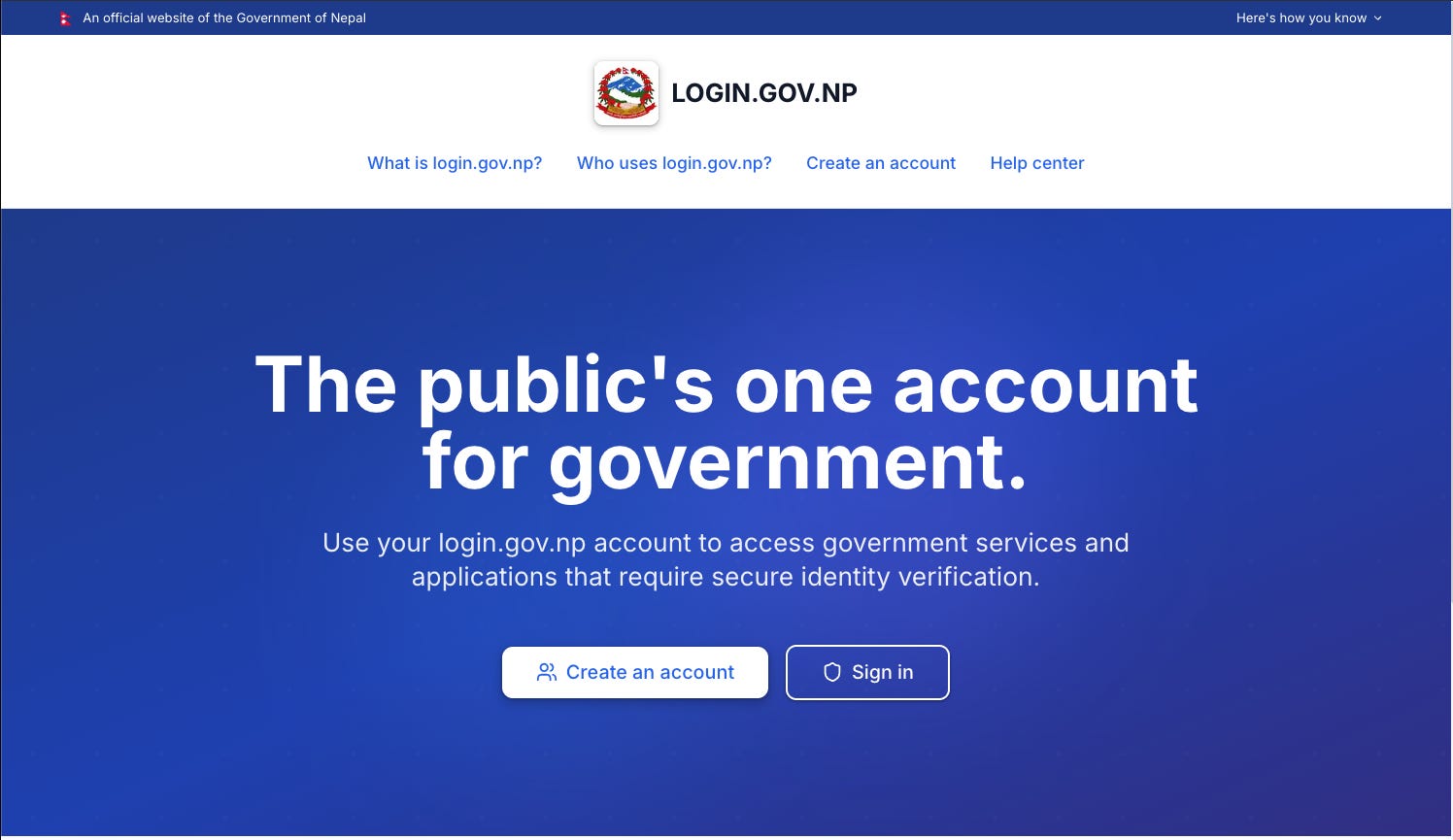
The Foundational Solution: login.gov.np is the proposed “whole-of-government” solution. It is not another “app” but rather a foundational piece of Digital Public Infrastructure (DPI). It will function as the single, secure, and trusted national Identity Provider. Through a Single Sign-On (SSO) architecture , a citizen, business, or government employee will authenticate once with login.gov.np to gain access to all participating government services, from federal tax portals to local e-services. It is the single, secure “front door” to the entire digital state.
The Value Proposition (Return on Investment): The adoption of this model, based on proven international precedents, will deliver immediate and long-term returns:
Secure the State: By centralizing authentication, login.gov.np allows for the mandatory enforcement of high-security standards, such as multi-factor authentication (MFA) , providing a unified, expert-led defense against the cyber-attacks that are currently overwhelming our fragmented systems.
Save Public Money: A unified IdP is vastly cheaper than our current duplicative model. A US government study found a single, shared IdP would have $40–$111 million less in initial costs than isolated, proprietary systems. Furthermore, it will eliminate massive fraud and leakage in Government-to-Person (G2P) payments (e.g., social security) by enabling cross-database verification, a practice that saved Thailand $29.7–$59.4 million in a single program.
Serve the Citizen: This system finally delivers a citizen-centric government. It ends the bureaucratic run-around and implements the “Only Once” principle by allowing secure, consent-based data sharing between ministries. This has been shown to save citizens an average of five working days per year in countries like Estonia.
Unlock the Digital Economy: A trusted national IdP is the single greatest enabler of the digital economy. It provides a secure, standardized electronic Know Your Customer (e-KYC) service for all private sector banks, telecoms, and FinTech companies , drastically reducing their customer onboarding costs-a model that saves Singapore’s banks S$50 per customer.
Part 2: The “MVP” is Already Live (Proof of Concept)
To convince skeptics, we point to what is already working in Nepal. The risks are low because the foundation is laid.
The Opportunity: Nepal does not need to “invent” a digital identity system from scratch. We already have the components of a world-class system in play. Our proposal is to unify these isolated successes into login.gov.np-a single, secure “digital key” for the nation.
We have two working solutions that prove the technology and demand exist:
1. The Citizen Success: Nagarik App
The Nagarik App is effectively the “beta” version of a national Single Sign-On (SSO).
What it proves: It proves that we can successfully link disparate government silos (Malpot, PAN, Passport, Voter ID) into a single user view.
The Limitation: It is currently just an app. You cannot use your “Nagarik Login” to sign into the Inland Revenue Department’s website on your computer.
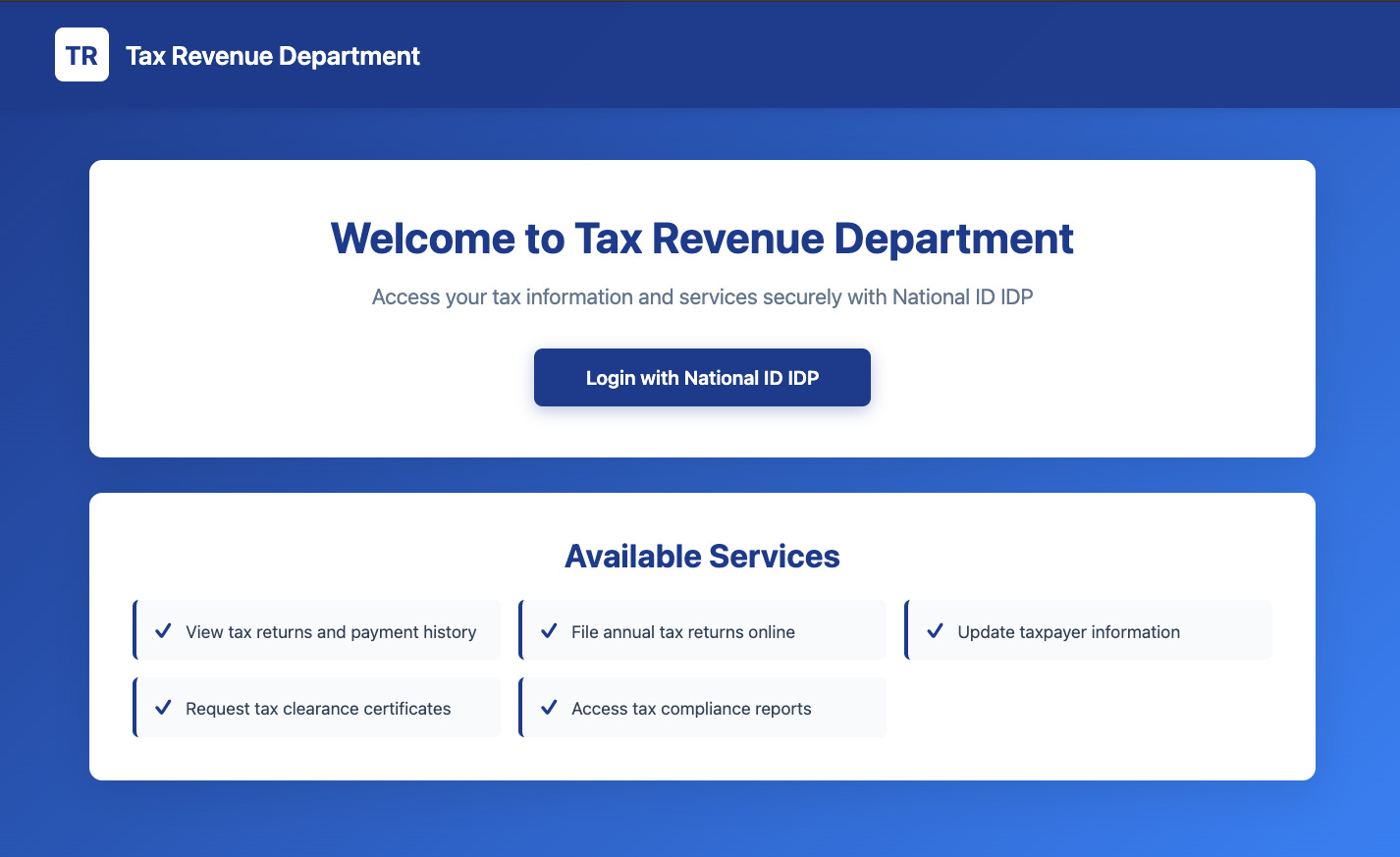
The login.gov.np Upgrade: We will extract the authentication logic from the Nagarik App and make it a universal “Login with Nepal” button for any website, similar to “Login with Google.”
2 The Business Success: GovDataAxis (CIB)
This is the most critical proof point for the private sector. The Credit Information Bureau (CIB) of Nepal has launched GovDataAxis, a gateway connecting the National ID database to banks.
What it proves: It proves the NID System can handle API calls for real-time verification. It enables KYCAuth (Identity Authentication) using the National Identity Number (NIN) and biometrics.
The Limitation: It is currently limited to the financial sector/CIB members.
The login.gov.np Upgrade: We will standardize this API access so any verified business (telecoms, insurance, startups) can use it, turning identity into a platform for economic growth.
The Missing Link: While these apps work, they are “walled gardens.” A citizen cannot use their Nagarik App credentials to log into a tax portal on a laptop, nor can a startup easily use NID for verification. The Solution: login.gov.np will act as the standardized bridge (Identity Provider). It takes the trust already established by the National ID and Nagarik App and extends it to every website and service—government or private.
The Return on Investment (ROI):
Zero-Risk Tech: We are scaling existing OIDC (OpenID Connect) technology used in the Nagarik App, not building experimental tech.
Fraud Elimination: Immediate stop to social security “ghost” payments by cross-referencing the NID live database.
Economic Boom: Slashes bank/telecom onboarding costs by ~80% (based on Singapore/India data) by automating KYC.
Part 3: The Imperative for Change: Nepal’s Fragmented Digital Landscape
3.1 The Systemic Cost of Digital Fragmentation
Nepal’s journey into e-governance is characterized by a “traditional governance system” struggling to adapt to new technology. The result is a landscape defined by deep, systemic fragmentation. Ministries and government departments continue to function in “silos” , leading to the “mushrooming of isolated, duplicative and often unsustainable systems”. A 2009 analysis of Nepal’s e-governance projects identified the “lack of interoperability” as a primary reason for their high failure rate, a finding that remains true today.
This fragmentation has tangible, negative consequences. It directly results in “data fragmentation and inefficiency” across the entire administrative state. Lacking a unified digital identity, the government remains reliant on “traditional paper-based citizenship certificates” as the primary trusted form of identification. This forces a reliance on manual processes that demand “a lot of time and human contacts”.
3.2 The Paradox of Federalism: Uncoordinated Digitalization
The 2015 Constitution brought unprecedented autonomy to local governments (LGs). While a democratic triumph, it has proven to be a technical challenge. This decentralization occurred “in the absence of coordinated national frameworks and technical oversight” , creating a “fragmented and opportunistic landscape” where every LG invents its own digital solutions.
A severe capability gap has emerged: while the federal government may have resources, local and provincial governments “often lack the knowledge, resources and capacity” to implement digital systems effectively. This has created a destructive dependency loop where LGs, unable to procure or manage their own infrastructure, deplete federal resources.
3.3 The Security & Legal “Time Bomb”
The most urgent imperative for a unified IdP is the clear and present danger to Nepal’s security. Our fragmented digital state is being built on a non-existent legal and security foundation.
Legal Vacuum: Nepal “currently lacks a comprehensive Personal Data Protection Act”. We are collecting sensitive citizen information without a legal framework to govern its use.
Active Threat: Cybercrime cases have “increased eightfold in the past five years,” surging to 19,730 in 2024. In the Kathmandu Valley alone, online fraud has amounted to over Rs 378.5 million since July 2024.
Part 4: Strategic Deep Dive: Why NID is Superior to SSN (and How to Maximize It)
A common misconception is that a National ID (NID) is just a “digital version” of the US Social Security Number (SSN). This is dangerous thinking. The SSN is an outdated, insecure identifier that was never designed for the digital age. Nepal’s NID is a modern, cryptographic platform.
To convince stakeholders, we must clearly articulate why the NID is better and how to deploy it correctly to be both Effective (useful) and Assuring (trusted).
4.1 The Core Flaw: Why the SSN is a “Godawful Authenticator”
The US SSN system is fundamentally broken because it treats a static number as a secret password.
Static & Insecure: The SSN is a permanent 9-digit number. Once stolen (as happened in the Equifax breach affecting 147 million people), it is compromised forever. It cannot be “changed” like a password.
Zero Assurance: Knowing someone’s SSN proves nothing. It does not prove the person is who they say they are; it only proves they know the number. This flaw is the root cause of massive identity theft in the US.
4.2 The NID Advantage: A Modern, Cryptographic Platform
Nepal’s NID is not just a number; it is a Smart Card Ecosystem backed by biometrics. It allows for Authentication, not just Identification.
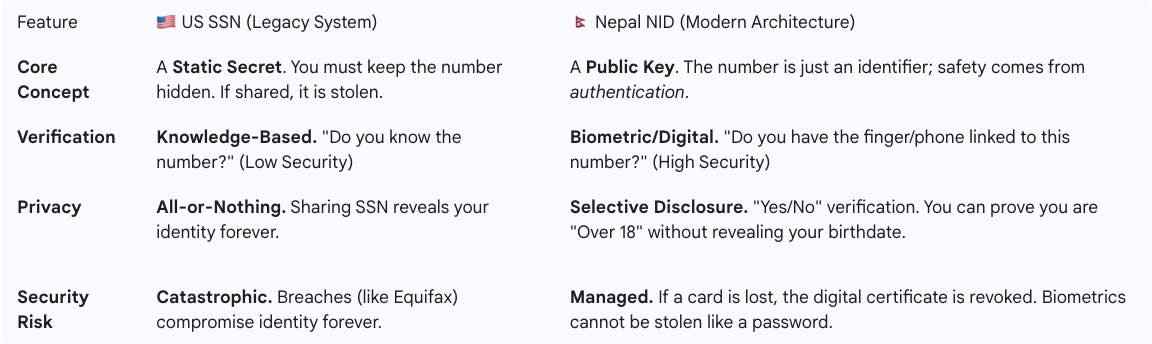
The Strategic Argument: The US is currently spending billions trying to fix the SSN vulnerability. Nepal has the advantage of leapfrogging directly to a cryptographic, biometric-backed system. We are not “catching up”; in this specific area, our architecture is ahead of the US legacy system.
4.3 Making NID “Effective”: The Utility Strategy
“Effectiveness” means the NID must be the only key a citizen needs to unlock value in the economy.
-
Mandate as the “Single Key”: The NID must replace the citizenship certificate for all high-value interactions: opening bank accounts, buying land, and applying for passports. The government has already started this by integrating NID with the Nagarik App for passport services.
-
The “Killer App”: e-KYC for the Private Sector: The NID must not remain a government-only tool. We must expose secure APIs (Application Programming Interfaces) to the private sector.
-
Bank Integration: Banks should use the NID API to perform instant, paperless e-KYC (electronic Know Your Customer). This reduces onboarding costs and eliminates fake accounts. The GovDataAxis platform by the Credit Information Bureau (CIB) is a perfect example of this emerging infrastructure.
-
Telecoms: SIM card registration should require biometric NID verification to eliminate fraudulent SIMs used in crimes.
-
4.4 Making NID “Assuring”: The Trust Strategy
“Assurance” means citizens trust the system not to spy on them or leak their data.
-
“Yes/No” Verification (The Privacy Shield): The NID system should offer a “Yes/No” API. When a bank checks a customer’s age, the NID system should simply reply “Yes” (verified) or “No” (failed), without revealing the citizen’s underlying personal data. This “Zero Knowledge” approach protects privacy while enabling business.
-
Offline Verification (The Connectivity Solution): Nepal has connectivity challenges. The NID card and the Nagarik App must feature a Digitally Signed QR Code. A police officer or bank teller can scan this QR code without internet access to verify the card is genuine. This brings digital trust to the most remote villages.
-
Biometric Locking: To build trust, give citizens control. Allow them to “lock” their biometrics via the Nagarik App. If a citizen isn’t using their ID, they lock it. Even if a hacker has their ID number, they cannot authenticate. This feature alone can massively boost public confidence.
Part 5: International Case Studies (Including SingPass)
5.1 Singapore’s SingPass & MyInfo: The Gold Standard for Consent
Nepal should look to Singapore not just for technology, but for its governance of consent.
-
The “MyInfo” Model: Singapore’s MyInfo service is the world’s best implementation of the “Only Once” principle. It is a “consent-based data platform”.
-
How it Works: When a Singaporean opens a bank account, they don’t fill out a form. They log in with SingPass, view their government-held data (Name, Income, Address), and click “I Agree” to share it with the bank.
-
The Result: This reduces bank transaction times by 80% and saves banks S$50 per customer in administrative costs.
-
Lesson for Nepal: login.gov.np should emulate this. Do not just share data; build a dashboard where Nepali citizens can see who is asking for their data and grant permission. This builds immense trust.
5.2 Estonia’s X-Road: The Architecture of Interoperability
-
Decentralization: Estonia does not put all data in one massive “honeypot” (which is a security risk). Instead, they use X-Road, a secure data exchange layer.
-
How it Works: The Health Ministry keeps health data; the Transport Ministry keeps license data. X-Road allows them to talk securely.
-
Lesson for Nepal: Do not try to build one giant database for everything. Build a “Nepali X-Road” that connects the existing NID database, Passport system, and local government servers securely.
5.3 The US Login.gov: A Model for Federalism & Inclusion
-
In-Person Proofing (IPP): To solve the “digital divide,” Login.gov allows citizens to verify their identity physically at over 18,000 Post Offices.
-
Lesson for Nepal: Nepal must mandate In-Person Proofing at Ward Offices. We cannot leave behind citizens who lack smartphones or internet access. A digital-only system in Nepal is an exclusionary system.
Part 6: The Value Proposition (Measurable ROI)
The implementation of a unified national IdP is not an IT expenditure; it is a high-yield national investment.
-
Massive Public Sector Savings: A NIST study estimated that a unified government credential (like login.gov.np) saves $40–$111 million in initial costs compared to agencies building their own proprietary systems. For Nepal, this means stopping the wasteful duplication of login systems across 753 local governments.
-
Eliminating G2P Fraud: By linking the NID to social security payments, Nepal can eliminate “ghost” beneficiaries. Thailand saved $29.7–$59.4 million in a single cash transfer program by using national ID cross-checks.
-
Boosting the Private Sector: Providing an NID-based e-KYC API to banks and telecoms will slash their operational costs. In Singapore, this infrastructure saves the financial sector millions annually and reduces application times by 80%.
Part 7: A Strategic Roadmap for Implementation
-
Phase 1: The Legal Shield (Months 1-6)
-
Pass the Personal Data Protection Act immediately. There can be no trusted digital ID without legal protection for citizen data.
-
Establish a dedicated, independent Data Protection Authority.
-
-
Phase 2: The Foundation (Months 6-12)
-
Launch login.gov.np with NID integration.
-
Mandate Offline QR Verification capability for all issued NID cards to ensure rural usability.
-
Establish In-Person Proofing (IPP) centers at Ward Offices to serve the offline population.
-
-
Phase 3: The Ecosystem (Months 12-24)
-
Launch the Private Sector API (GovDataAxis model) for banks and telecoms to enable paperless e-KYC.
-
Implement the “MyInfo” Consent Dashboard, allowing citizens to view and control who accesses their data.
-
Conclusion: Nepal stands at a crossroads. We can continue with a fragmented, insecure, and expensive patchwork of systems, or we can build a unified, secure foundation. The NID, if implemented as a dynamic service rather than just a static card, offers a leapfrog opportunity. By adopting the login.gov.np strategy, Nepal does not just catch up to the developed world; it builds a digital infrastructure that is more secure, more efficient, and more democratic than what many Western nations currently possess.
The pieces of the puzzle are sitting on the table. We have the Nagarik App (User Interface), the NID Database (Source of Truth), and GovDataAxis (Business Logic).
What is missing is the Orchestration.
login.gov.np is that orchestrator. By treating identity as a National Platform rather than a security card, Nepal can secure its digital borders, save billions in administrative waste, and unleash a private-sector fintech revolution. The MVP is live. The opportunity to scale is here. Now is the moment to build a digital future worthy of Nepal’s ambitions.
(Author KC is a cloud and security architect, exploring AI and crypto while connecting innovation with governance, security with freedom and technology with society for builders, leaders, and curious minds.)
पछिल्लो अध्यावधिक: मंसिर २०, २०८२ १५:४०


